
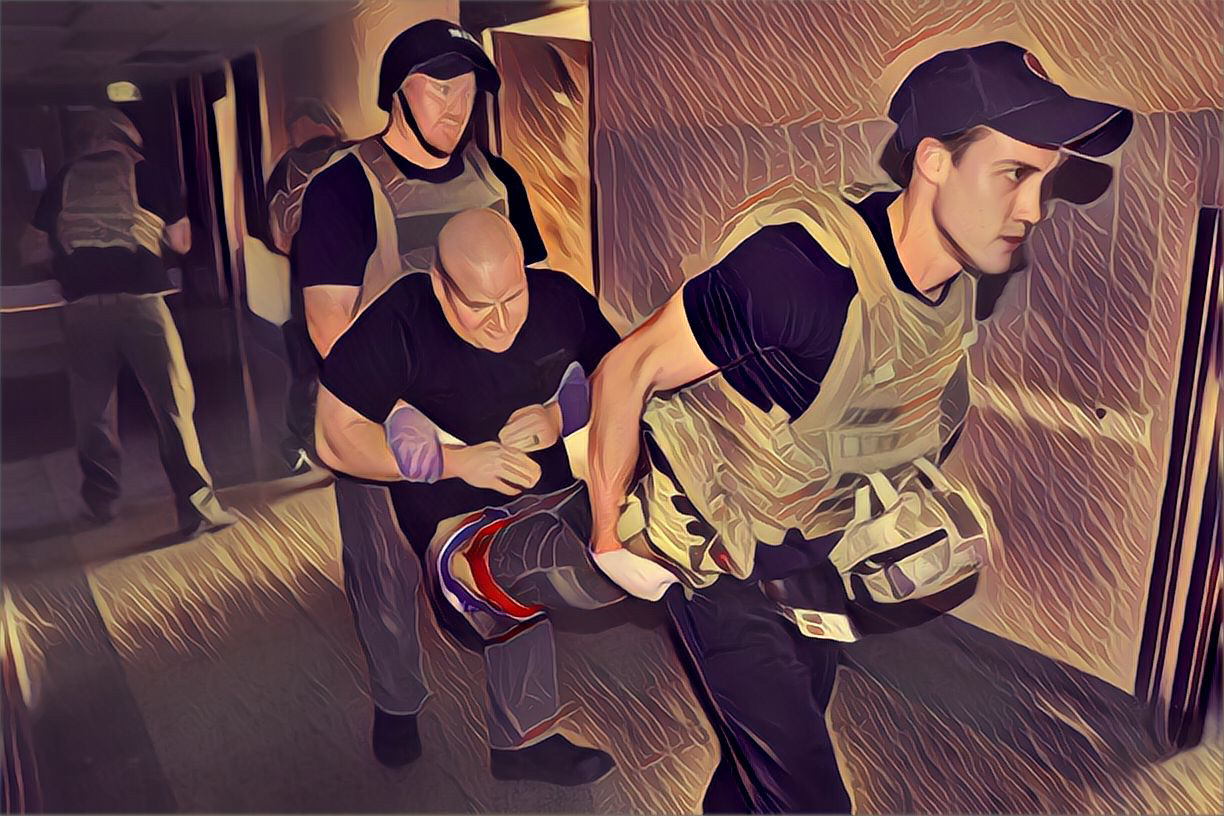
Who can use Tactical Medical Training?
Short answer…everyone!
Tactical Medical Training does not limit itself to only dangerous enviroments, rather it is life saving techniques that can be utilized at home, at work and even while traveling. This type of training makes you a better prepared citizen or first responder.
Tactical Medicine involves various medical interventions used in dangerous situations. Our courses follow the standards established by the Committee on Tactical Combat Casualty Care (TCCC), which have been adapted for civilian use by the Committee on Tactical Emergency Casualty Care (TECC). These standards cover different areas, including:
- Self-Intervention in a Tactical Environment
- Stop the Bleed
- Active Bystander Casualty Care
- Armed Citizen Casualty Care (CHCL or CC)
- First Responder Casualty Care
- Law Enforcement Casualty Care
- Basic Level Casualty Care
- Pediatric Casualty Care
- Advanced Level Casualty Care
- Casualty Evacuation
- Continuing Casualty Care and Evaluation
Our courses combine conform to the Committee on Tactical Emergency Casualty Care Guidelines, National Fire Protection Association – NFPA 3000 Standards, and the Federal Law Enforcement Trainning Center (FLETC) training guidelines.
Basic courses are generally one 8 to 12 hour day although some may last up to 16 hours if operations at night are included. Some advanced courses may continue over several days. Course schedules are included prior to sign up.
Medical continuing education training hours can be requested and are granted through the National Association of Emergency Medical Technicians (NAEMT).*
*NAEMT Certificates incur additional fees.
Tactical Medical Courses
- Stop The Bleed – Basic course learning the skills needed to intervene in cases of massive hemorrhaging. Includes the use of tourniquets, junctional injuries, airway issues, and heat/cold emergencies related to blood loss. Link to more info: https://www.stopthebleed.org/resources-poster-booklet/
- Advanced Tactical Self-Aid – Advanced self-aid skill course involving the utilization of intervention skills while restricted and in a dangerous environment. This course was developed by our instructors, incorporating over 50 years of emergency medical and tactical skills experience. Includes self use of tourniquets, junctional wounds, care under fire, and live fire exercises.
- Tactical Incident Care and Skills (TICS)/ Active Bystander Care – Course designed for the prepared citizen involved in an active killing event. Skills involved are designed to challenge participants in triaging, utilizing interventions in a hostile environment, and understanding the priorities of tactical environment care. Link to standards included: https://tacrescue.com/wp-content/uploads/2025/07/f_tecc_activebystander2024_final.pdf
- First Responder/ Law Enforcement Casualty Care – Because first responders run into dangerous environments, these courses designed to include the active bystander skills along with tactics for first responding caregivers. Conforming to the CoTECC Standards this course includes the basics of managing an active killer environment, officer down, and rapid interventions. Link to standards: https://tacrescue.com/wp-content/uploads/2025/07/f_tecc_activebystander2024_final-1.pdf
- Tactical Emergency Casualty Care Basic and Advanced Level – Courses designed around medical care providers in a tactical environment. This course requires a minimum medical certification level of NREMT-B as a prerequisite. Includes hemorrhage intervention, airway adjuncts, chest decompression, IV/IO access, advanced airways, junctional devices and more. We also include operational information on how to incorporate with law enforcement and SWAT teams for active killing scenarios. Link to Standards: https://tacrescue.com/wp-content/uploads/2025/07/f_tecc_als_bls_guidelines_2025_final.pdf
- Pediatric Tactical Care – Covers specialized trauma care in regards to children and young adults. This area of instruction is incorporated into our TECC Basic/ Advanced courses with interventions included in our active bystander course as well.
- Refresher courses for all of the above are also available.

 tacrescue.com